Previous entries — Part One, Introduction; Part Two, Electoral Politics; Part Three, Labor; Part Four, Diversity in the SPA
The 1910s were a period of opportunity for socialist organizing across the world, and represented the peak of mass membership in socialist organizations in the United States. The country’s economic inequality was becoming more salient, with the First World War exacerbating these dynamics as working people were being sent to their death for the profit of the wealthy. The SPA was able to take advantage of these conditions to build a mass socialist organization which this country has not seen before or since, but it ultimately failed in its mission to transform society. The causes of the party’s collapse are multifaceted, including its aforementioned failure to embrace the multiracial, multigendered working class, as well as state repression and heightened internal party conflict.
As the 1910s went on, the left wing of the SPA consolidated, with Ruthenberg as an important leader of the faction that would be increasingly in tension with the party’s incumbent leadership. Many left-wing leaders, such as legendary IWW organizer Bill Haywood, would be accused by fellow members of supporting violence and sabotage, implicating them in legal proceedings and removing them from party office. Despite Ruthenberg’s rejection of these tactics, he was similarly removed from state party leadership in 1912. In Ohio, Ruthenberg and his allies still had strong support, and may have been able to defeat this motion were it not for his ongoing gubernatorial campaign. Elsewhere, however, the right wing of the party was more solidly in control. In many locals, these attacks, often on left-wing labor organizers connected to the IWW, led to a significant exodus from the party throughout the 1910s.
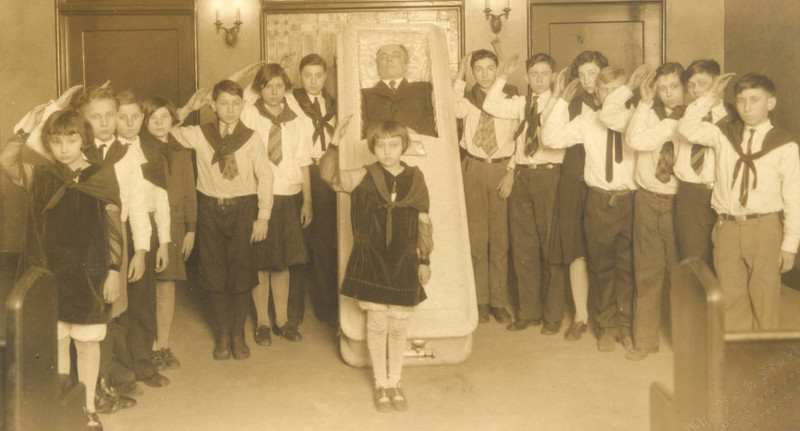
However, things were different in Cleveland. From 1912 to 1919, as national membership declined or stagnated, Cleveland’s local would see immense growth. With more than 3,000 of the Ohio SPA’s 8,000+ members in 1919, they would present a major success story for the party’s left wing. The local’s internal structures were a crucial part of building this connection to the masses. They emphasized political education, particularly on Marxist theory. This ranged from establishing a Socialist Sunday School for children to speeches from figures such as Karl Liebknecht and Bill Haywood. The party also held cultural events and fundraisers for adults, while developing a Young People’s Socialist League which included bowling matches, dances and baseball games. These opportunities allowed party members to not only organize politically, but develop socialist culture and community with their comrades.
In 1917, the US formally entered World War One, despite President Wilson’s campaign promise to maintain peace. In reaction, the SPA held an emergency convention in St. Louis, where leaders across the organization, including Ruthenberg, drafted an anti-war resolution. Many workers, who did not want to be sent overseas and fight in a brutal war, were increasingly drawn to socialist politics. Cleveland’s well-organized local, with a clear left wing politics that consistently stood against imperialis, was well positioned to take advantage of this. In 1917, the Cleveland Local saw its best ever electoral results, with SPA candidates J.G. Willert and Noah Mandelkorn elected to Cleveland City Council and A.L. Hitchcock elected to the school board. Additionally, Ruthenberg’s Mayoral campaign, calling for “socialism, peace and democracy” would win close to 30% of the vote. While socialists were not in the majority, they were gaining in popularity among workers, and the ruling class was starting to notice.
Soon, the harassment, censorship, imprisonment and deportation of socialists and the broader anti-war movement would escalate. In 1918, Cleveland’s two socialist city councilors and school board member would be removed from their positions for opposing the war. Ruthenberg was fired from his job and repeatedly arrested for anti-war speech along with many of his comrades. This culminated in the previously mentioned anti-worker judge David Westenhaver sentencing Ruthenberg to a year in the Canton work camp.
During his time in Canton, Ruthenberg was informed of the success of the Bolshevik revolution in Russia. The Cleveland local had held a 2,500 person celebration that February of the Tsar’s overthrow, and the enthusiasm continued to grow as they heard of this news. Ruthenberg himself found a lot of inspiration from the Bolsheviks and the writings of Lenin, which were at that point not very commonly read among the socialists in the US. Under his leadership, the Cleveland local would lead the SPA in becoming an outspoken proponent of solidarity with the Russian revolution, and opposition to US military intervention on behalf of the White Army.
For the next couple of years, Ruthenberg and Eugene Debs would be repeatedly imprisoned, often directly calling for the other’s release. At the 1918 Ohio Socialist Party convention, held within view from Ruthenberg’s prison cell, Eugene Debs would give his famous Canton Speech, calling for Ruthenberg’s freedom and an end to the US involvement in the war. Debs would subsequently be arrested for this speech, and sentenced to ten years in prison by, once again, Judge David Westenhaver. Once Ruthenberg was released from detention,he would help organize multiple rallies calling for Debs’ freedom, culminating in the 1919 May Day demonstration, which would once again land him in jail.
The events of May 1st, 1919 represent the peak of mass socialist presence in Cleveland, with 30,000 workers, led by the Socialist Party and including many IWW and AFL members, marching through the streets. The demonstration called for the economic demands of work for the unemployed and an increased minimum wage alongside calls for international solidarity and opposition to war. The workers held Red Flags and American Flags as they marched towards Public Square. This display was considered offensive by one businessman, who drew a revolver on a socialist WW1 veteran holding a red flag. Soon thereafter, the police, who had until that point been oddly absent, would descend on the demonstration, and along with other right wing members of the public, beat and arrest over 150 workers. Two workers would be killed by the police that day, and the socialist party headquarters would be ransacked. In the next day’s issue, The Plain Dealer would describe the violence as followed:
“Mounted police at the gallop wielding truncheons on the heads of Bolsheviki, citizens and soldiers tearing red flags and trampling them in the mud, [and] tanks from the western battle front charging crowds in the front of the statue of Tom Johnson”
Today, this event is commonly known as the May Day Riot. One could embrace that term, in the spirit of Martin Luther King Jr.’s famous proclamation that “a riot is the language of the unheard.” Alternatively, you could describe what happened as a peaceful demonstration and a subsequent massacre. The violence was provoked by the reactionaries, and actions taken by socialists were largely in self-defense. Ultimately, while the May Day demonstration led to another round of arrests and imprisonments for socialist leaders like Ruthenberg, it also coincided with the continued growth of Cleveland local, with hundreds more joining that month.
From this point onward, the repression of socialist and anti-war organizers would continue to escalate, while the Socialist Party was facing extreme internal turmoil. Ruthenberg and others on the left wing of the party would formalize their internal faction, and win 12 of the 15 National Executive Committee seats. However, the incumbent SPA leadership refused to recognize these results, eventually leading to a mass exodus of party members, either through expulsion or resignation. What followed was a messy process which eventually culminated in the establishment of the Communist Party of the United States of America (CPUSA), led by General Secretary C.E. Ruthenberg.
This split, alongside the continued repression of the movement, was the final nail in the coffin. The SPA would continue to operate, but no longer holding its same mass reach, with the party falling to 10,000 members by 1923. Socialist organizing would continue elsewhere, of course, including in Ruthenberg’s CPUSA. However, no US organization has since reached the peaks of the SPA’s 113,000 members in a country of less than 100 million. Learning from this period, we cannot understand the organizing of the past solely through modern lenses. The historical development of capitalism and the US political system placed 1910s SPA organizers in very different positions than DSA members in 2026. However, there are still some conclusions we can draw from the electoral and labor organizing of the party, as well as its demographic makeup and internal structures.
For both electoral and labor organizing, the conditions of the 1910s were dramatically different, but ultimately the SPA’s success showed the importance of the slow and steady work of constructing a socialist organization. Engaging the masses with a socialist vision requires a commitment to improving their lives in the short term, while maintaining our principled vision for a socialist future. This can come through electoral campaigns, and through solidarity with the workers fighting for better conditions at work.
On the other hand, the SPA’s failures demonstrate the need for constructing a culture within our organization which is welcoming, stands clearly against bigotry, and accepts political conflict while striving for unity in action. No resolution or policy alone can make our organization more diverse, but a welcoming attitude and constant, proactive thinking within each part of our organizing work can help. Similarly, no moderation or grievance policy alone can prevent the worst forms of interpersonal conflict or political repression. These policies are the first step, which must be accompanied by conducting ourselves in a comradely way for the next thousand steps.
Of course, there are things we cannot control – like the actions of our enemies. We do not know how or when the socialist movement will face additional state repression. But one lesson of the SPA, and any other successful socialist movement, is that our opposition will not sit idly by while we work to build ourselves up. With that in mind, I will end with the last words of C.E. Ruthenberg, reported after his death in 1927:
“Tell the comrades to close their ranks, to build the party. The American working class, under the leadership of our party and the Comintern, will win. Let’s fight on!”