
by Justin W
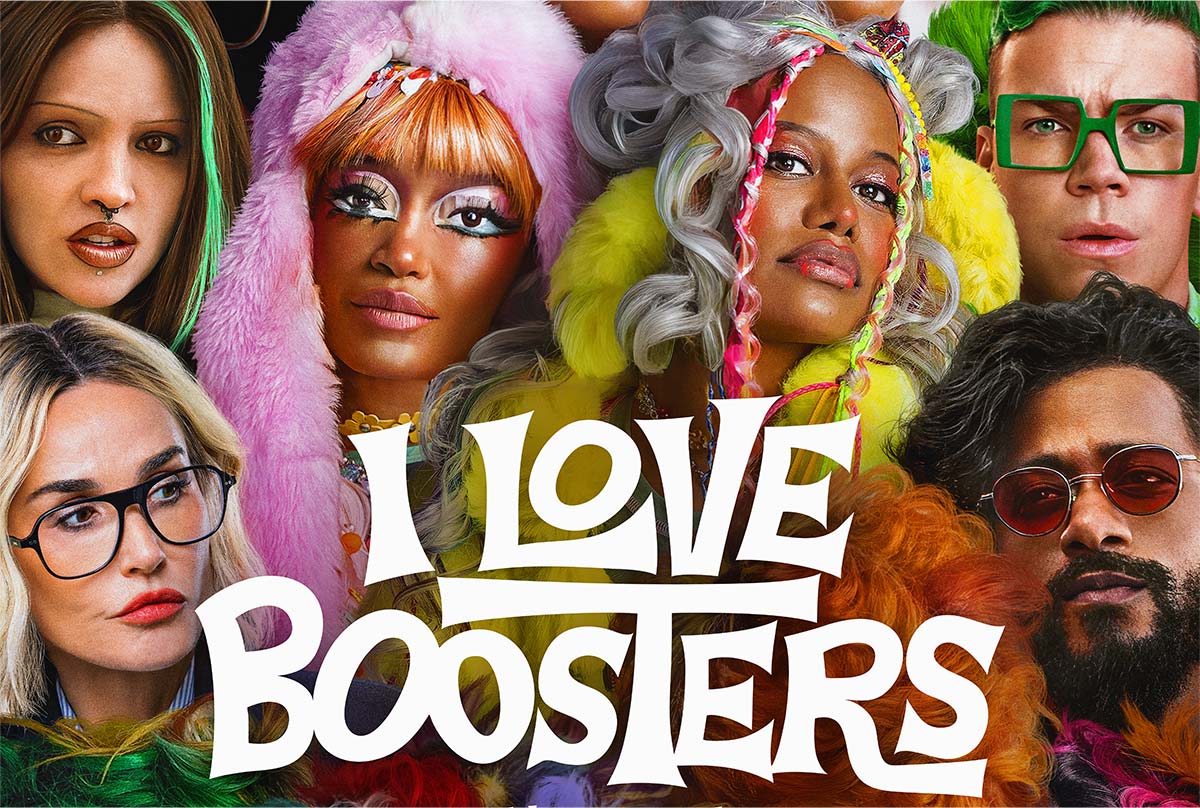
I Love Boosters is a story about a trio of “boosters,” women who steal from department stores and resell the items to the community, and their fight against a local billionaire. The billionaire’s name is Christie Smith, whom one of them admires so much she has her platitudes memorized, which makes for a complicated relationship that evolves as the movie goes along. The CEO is very clearly a genius, having graduated college at 17 and spent years working in physics departments, but her platitudes still sound just as vapid and amorphous as any other CEO or motivational speaker. During their heists the trio find a Chinese worker who steals the designer wear so quickly they legitimately believes she has a magic bag, and given that this is a Boots Riley film, you believe it too until it’s revealed to be a teleporter.
The Chinese factory worker, Jianhu, is stealing the clothes as a way to attack Christie Smith for the horrible conditions in the factory she and her family work in. This brings the trio and Jianhu together as they start stealing more from Christie Smith. As they’re in the process of stealing clothes a discovery is made: The teleporter does more than teleport, it deconstructs and accelerates the contradictions as well. It becomes clear this is a machine based on Dialectical Materialism as the machine brings two things together (teleports), it deconstructs (as shown when they deconstruct clothes into their base components AND when they aim it at a person and turn that person into their parents having sex), and it accelerates the contradictions of a given entity (a cop car is turned into a parody of overmilitarization and reconstructs a person from their parents from before).
This leads to the personal conflicts in the movie and what I believe to be the thesis. We have the main character Corvette and her best friend Sade, one who is trying to overcome the ills brought about by capitalism (Sade) and the other who is so lonely a loneliness demon tries to pick her up on multiple occasions (Corvette). Sade sees MLM marketing as the way through the ills of capitalism and Corvette sees vengeance as her way out of her loneliness. This is resolved when they link their struggle against Christie Smith to the workers both in China who are making the clothes as well as the workers building a union to stand up against the billionaire. The resolution is built through the combining of the efforts of all workers against Christie Smith and the fashion industry, starting in China and the United States but then the rest of the world, and the community organizing that needs to happen to build those strikes and protests.
We see this through Corvette rejecting the loneliness demon and her confronting the rolling ball of bills, tickets, and failures of Corvette’s past (seen the entire movie following her just out of sight of everyone else), which shrinks once she has a community to help her deal with those problems. The problems are still there, just reduced to a more manageable size.
Given this is a Boots Riley film, there are some incredible design and artistic choices that combine to create wonderful metaphors. The CEOs office is tilted, showing her skewed view of the world. The loneliness demon who has been around for millenia can only remember two years back when they were lost in a Target, or, one might say, lost in a capitalist hellscape (please listen to the song “Lost in the Supermarket” by The Clash). At one point some characters who have been seen interviewed on TV take off their skins, revealing that they play characters on TV (like workers arguing for less pay and benefits as well as Candace Owens, among others) or lead MLMs to generate in people the need for more brutal cop tactics, anti-worker propaganda, and false solutions (like MLMs) as part of a campaign created by the billionaire to reduce in workers the desire for real solutions like collective action.
The skin suits also demonstrate how those with anti-worker sentiments but still working class themselves literally sell their identities to be used and interchanged by anyone who needs them for whatever purpose. They give away their ability to identify themselves for the purpose of fulfilling the whims and desires of a billionaire. In true Boots Riley fashion, he tries to make the metaphors as overt as possible, with a little bit of surrealism thrown in the mix. The comedic elements of the movie shine through these metaphors and are so littered throughout I am very surprised the movie isn’t considered a comedy. Boots Riley’s love of storytelling and visual metaphor make him one of my favorite directors and this was terrific and just the right amount of silliness to push through the slightly radical position he’s leading towards through the film.
But this wouldn’t be a Marxist take on a very overtly Marxist movie (the main catalyst for the movie is a Dialectic Materialism machine) without some discussion on the theory presented. The Dialectical Materialism machine is initially seen only as a teleporter, but later in the movie a union organizer explains the full functionality, urging the trio to use it to help them accelerate people into the union they’re building. Initially, the Velvet Gang (the name of the boosters’ group) turns her down in favor of their plan to simply steal from the billionaire thinking that would be enough. As the movie progresses and we reach the climax of the film, the machine is used to link the struggles of the union in the United States to the factory workers in China, creating the solidarity needed to fight against their collective boss.
Through the explanation of the functions of the machine we get a decent description of dialectical materialism, in a way that is simple enough that we can progress with the movie, while still being faithful to the concept itself. I think Boots’ decision to purposefully inject actual theory into the movie gives a stepping stone for those who like the movie something to grasp onto when deciding to work on their own politics, but does mean the resolution of the movie cannot be as explicit in the direction I think we should go. The CEO is not removed nor a communist revolution waged by the end of this film, instead a worldwide strike against the fashion industry is started, and characters from the movie are seen leading the union in their fight for a better wage, though the main characters are not participants. The most recent film to have such overt Marxist themes, also made by a black director, is Sinners.
Sinners, for those who haven’t seen it (Why haven’t you? Go watch it!) has a black community fighting against a vampire who uses racism to escape from justice and controls the actions of those whom he has bitten. It is a story about a blood sucking parasite who had oppression forced on him years ago and wants to forcibly create the community he lost due to colonialism and imperialism by stealing the music and soul of a community that hasn’t yet lost themselves to that same oppressive force. The black community fights and kills the vampire, in a bloody struggle that lasts all night, ending with one character killing the racists who came to kill him. In interviews following the release of the film, director Ryan Coogler was asked multiple times about the Marxist implications of the movie and what was being said through the metaphors, every time keeping silent about what he wrote. He could not, at any point, be explicit in the aims and messaging of his movie, lest he lose what position he has to make films like Sinners again. He was able to show the action of the theory, but wasn’t allowed to be explicit in the ideology that created it.
I see Boots Riley’s choice to name the theory but not show the action as the flip side of the coin. Even on a good day Hollywood would not allow both sides of the coin to be shown on screen at the same time, as Capital knows what it can allow anti-capitalist art to show, as well as what it can’t. Were I Love Boosters to show the fall of capitalism and say the words “Dialectical Materialism,” a producer would have simply shut down the movie and not let it see the light of day. There must be a balance struck between what can be said and what can be shown while still being funded by those who would otherwise be the target of said action or the villain of theory. The theory of the film is presented in a relatively clear way, but the film needed to reel in the actions shown to compensate. When we say “The Revolution will not be televised” this is an example. You can see that revolutions happen or you can hear theory be spoken, but never the twain shall meet, at least not on the big screen. So we need to read between the lines, and see the direction Boots Riley or Ryan Coogler are pointing us in. (On a related note, come join us at Book Club sometime.)
Overall, this movie is terrific and I recommend everyone go see it. The bright colors, wonderful fashion, comedic style, and the only just so slightly over the top surrealism blend together into a wonderful movie that I would definitely watch again, and recommend others watch too. Combined with the theory hilariously intertwined into the movie, it is one of the best movies I have ever seen and I want to hear your thoughts on it too.