
Author: Russell K.
Like most of you, I have seen the daily horrors in Minneapolis from the deceptively secure distance of my phone and my television. I have seen, a dozen times, the murder of an innocent woman by masked criminals with badges. I have seen through these screens how she was smeared, how the Trump administration reacted, and how the situation escalated in Minneapolis.
ICE has created a deliberate environment of fear and intimidation. There is no other reason for them to be patrolling schools and grocery stores and even churches. It is true that they have brought terror upon the people of Minneapolis, but the people have shown great courage in resisting these masked criminals. The motivated people of Minnesota have put their lives and careers in jeopardy to protect the least among them and their example should inspire us all. Particularly relevant to us is the rumor that ICE will soon be surging to Springfield, Ohio. Should this be true, their example poses a challenge to us – do we have the strength and courage to resist as they have? Or will we prioritize our own safety and comfort over the lives of our neighbors?
Video upon video exists of heavily armed masked men prowling the streets, breaking into homes and cars, and splitting up families. But I saw, too, how the people of Minneapolis resisted. How they refused to stand idly by and watch their neighbors become victims. Finally, I was told that while what I was seeing online from ICE was bad, it was worse on the ground. Eventually I decided to see if that was true, to go and see how the ground looked for myself.


The people of the Twin Cities and Minnesota are enduring a great ordeal. They are tired, but they remain determined to resist. They are scared, but despite all they have endured, their hope remains undiminished. ICE themselves have made no secret of what they are doing – they are deliberately terrorizing the people of Minnesota. According to a DSA member I grew acquainted with: “Everyone here has been tear-gassed or knows someone who has.” She herself was tear-gassed by state police when people protested the shooting of a Venezuelan man by ICE in the north of the city.
Efforts have been made to document as much of ICE’s violence as possible. Photos and videos were encouraged and forwarded to the ACLU in the hopes of eventual prosecution. The following is my own small piece of documentation, a recollection of the time I spent in Minneapolis.
Tuesday (1/20):
I arrived on Monday night, but Tuesday was my first full day in Minneapolis. Having signed up to Twin Cities DSA’s (TCDSA)’s daily ICE bulletin, I read about a church, Dios Habla Hoy (DHH), that was giving out food to families sheltering in place, so I started the day there.
I arrived and joined in lifting boxes. The center of the church had been turned into a ring of tables, where one person would bring a box into the circle for another to stock it from outside. The box would reach the end and be handed off to a human chain of people. The box would then make its journey down the steps and be loaded into a truck, where it would be brought to the loading station outside for drivers. There could be as many as three human chains at any given time, bringing food deliveries inside and prepped food outside.
Speaking with TZ, a knowledgeable volunteer who was handling driver registrations, I learned about the church. They had only started distributing in December with just 20 families. By the time I spoke with them, they were making 800 to 1,000 deliveries each day. They sourced food from donations, food banks, and recyclers. Nearly every building in Minneapolis I entered had tables piled with supplies. They often had too many volunteers, to the point where the general chaos could slow them down, but they were grateful for the efforts of people and were holding trainings constantly.
After lifting many boxes and planning to return for driver training (it was technically full, but TZ, understanding my limited time, snagged me a seat), I volunteered to stand watch outside. My hour and a half watch was mostly uneventful, but the church was being watched. At some point, three large vehicles with New Mexico plates showed up in short succession at the restaurant across from the church. We suspected ICE. Two patrollers came, sat near them at the restaurant, and all but confirmed them to be so. This had become quite normal for the church over the past weeks. After leaving DHH this evening, I would encounter my first, but not last, still running vehicle on the side of the road from which ICE had abducted the driver.
Later that evening, I arrived outside the TCDSA chapter’s office. I did not have a personal contact, but the calendar said that a meeting was taking place inside. Given the cars and the lit windows, I assumed this to be true. I rang a buzzer, but I was not let in. I occupied myself outside, reading. Eventually a comrade left the building, and I greeted them at the door. We spoke for a few minutes, I showed him my membership card, and I was brought into the office where a number of comrades were chatting. They have a lovely office, I must say, but they did not want it photographed.
I spoke with a few of them before a person by the name of J came in. J is the TCDSA’s membership coordinator and began to explain and answer questions on what activities chapter members were doing and what TCDSA as a whole had been up to. Early on, TCDSA had realized that they probably wouldn’t be able to manage a city-wide network but that they could act as organizers and other supportive roles. He did note that, over time, they had risen to lead several neighborhood response teams. He would explain that they had been preparing adequate structures since before the occupation had begun but that there were things that simply could not have been done before the invasion. Beforehand, 24/7 neighborhood watches would not only have been very difficult to maintain, but likely a waste of capacity. After the invasion, they became necessary – and very possible – due to the efforts of motivated volunteers. It was through resources and QR codes that J provided that I got plugged into my first Signal chats and was able to go on patrol – watching, recording, and notifying local communities of ICE activity.
Wednesday (1/21):
I responded to a call where off-duty ICE agents were spotted at a restaurant and spoke with a manager. They stated they did not need backup or anything, but employees were scared. Some volunteers would drive them home.
Later that night, I responded to a call. It had been relayed to our Signal from the downtown RR (rapid response) that a number of ICE agents were at a hotel and staff were afraid. I was quite late to the scene, about 30 minutes after the call had been forwarded. Word had it that an FBI agent or two and a squad of DHS had entered the building only to be chased out by the hotel’s patrons. It had been those same patrons who had spotted them getting ready in the hotel parking lot and sounded the alarm.
Regardless, several staff members and patrons were terrified and we helped make arrangements for them to get home via volunteer drivers and family. Most were secreted out the back entrance, but I remember a young Asian lady who came out the front and looked quite shaken. Given that we saw ICE agents circling the building like vultures, the group of us bunched tightly around her so she couldn’t be seen, quickly got her to a waiting vehicle, and watched her ride leave as we anxiously waited to see if anybody gave chase. We stayed on watch for another half hour or so in the cold night before dispersing.
Thursday (1/22):
My morning started with a conversation with K of the TCDSA comms committee. ICE activities are constant and omnipresent. Neighborhood RR works best because they can arrive on scene so quickly. Quite literally as I was sitting down to speak with K, not even five hundred feet from the coffee shop, ICE was spotted. K, a number of others, and I descended on the scene and ICE soon drove off. This is a clear example of how quickly we can respond to ICE, but it is equally evidence of ICE’s own ubiquity. They can appear anywhere at any time.


The TCDSA has gone through a lot. They recognized early on that they had neither the capacity nor the structures to respond to ICE throughout the city. Instead, they chose to organize, handle outreach, and do all the boring but important desk work required to make everything function behind the scenes.
According to a steering member of TCSDA, “We need to make peace with the fact that we will not be throwing tear gas back at them, we will be the ones organizing and onboarding new volunteers.” Luckily, they had put together a contingency plan back in autumn. This plan was not perfect, obviously, but it gave them an edge when the situation got out of control. Notably, this plan was initially conceived due to the National Guard’s occupation of D.C., rather than any ICE raid.
TCDSA and every other organization has received a huge influx of support – even people with no political background have been agitated into action. This has been both a boon and a challenge. Emergency training has been ongoing and many people have been diverted into neighborhood response teams and other work. K expressed concern that a prolonged occupation could exhaust the city and noted that nearly all other chapter activities have been paused.
When K first came into her position as comms coordinator, it was her and one or two other people. She had been in the general process of expanding the team when the occupation began. Since then, the team has expanded greatly, with volunteers dedicated to social media, K handling the press, and another group for vetting reporters and outlets. The team does have a lack of media-trained personnel, but there is an emergency training very soon.
K has been inundated with requests from the press on the situation. She mentioned that the local press had been more hostile to TCDSA than national reporting. But even international press and documentary crews have been spotted, including outside the Whipple building, a federal stronghold that acts as ICE’s central hub in Minneapolis. It is large, fenced off, and directly connected to the neighboring Fort Snelling, which itself has a sordid history with the local Native nations. The Whipple building is where immigrants and detainees have been taken by ICE and where all manner of abuse has been perpetrated. I personally saw Chinese reporters at the Whipple building and a French reporter outside where Vice President JD Vance spoke later that evening.

The TCDSA has generally criticized state officials for their weak statements and lack of meaningful responses, reserving their praise for the city council. Much of their work has been dedicated to turnout for the ICEOUT protest on the 23rd of January. There has also been an effort to canvas businesses, in order to establish contact, teach them how they can respond in a crisis, find out if they have a plan for vulnerable employees, and provide them with resources. Many businesses and buildings throughout the metro area have put up signs designating them as private spaces, prohibiting the entry of law enforcement without a warrant or their use as staging areas.
Speaking on law enforcement, K said that though she wouldn’t be surprised to see state police help ICE, as they have mostly been suppressing protestors, such as when she, herself, was tear gassed by them. The local police, though, have mostly tried to stay out of it, seeking to protect what little remains of their reputation since George Floyd.
Many protesters have been detained in the Whipple building. They have been held upwards of 72 hours without probable cause, denied food and water, denied medical attention, denied bathroom facilities, denied legal counsel, been photographed and documented, and generally been abused, berated, and harassed by facility staff. It would be more surprising to say that a person had not yet died within the Whipple than to suggest the opposite.
After finishing with K, I would next go to the Royalston in downtown Minneapolis where Vice President Vance had flown into town. The protest was quite small (everyone else was at home, work, or on patrol) but we had the company of two couches, modified in mockery with large, long-lashed googly eyes and a pink-fabric makeover, which the Secret Service present found amusing. They were surprisingly chill. We even got to explain to one of the older agents that the couches were in reference to an Internet rumor that back in college, JD Vance had had sexual relations with a sofa. Sadly, the Vice President did not pass by us or our couches, but ‘colorful’ insults were thrown at Gregory Bovino, suggesting he consider employment with Willy Wonka. It was around this time today that the temperature really got cold as the wind picked up.


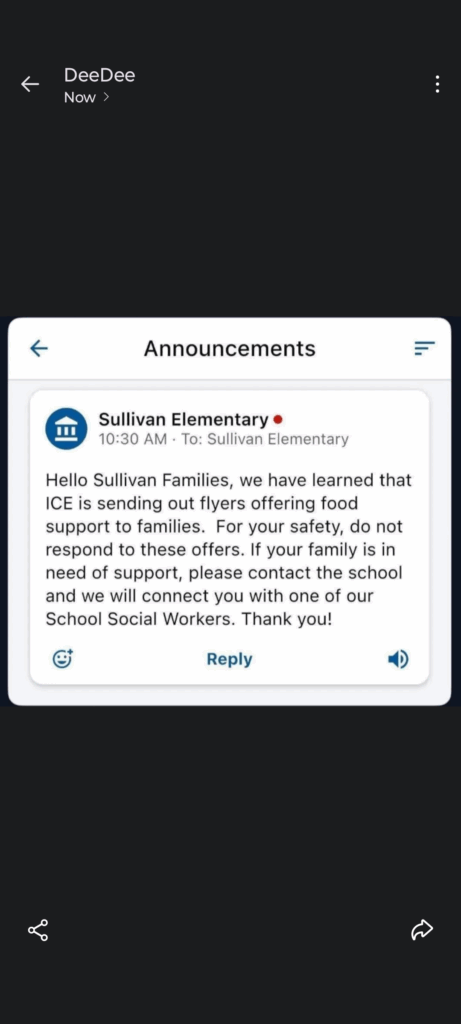
Dios Habla Hoy was my next stop, where I attended a training session for delivery drivers. Among many things, TZ made it clear to all that the church was being watched and drivers had reported being followed. While no drivers had been grabbed (or worse), participation did carry risk. This caution also extended to their recipients, and it was clear that there were a number of protocols in place to keep them safe (personal information was kept only on paper, ready to be destroyed). I should note that ICE is attempting to impersonate DHH and other churches in order to lure in victims, much like the U.S.-sanctioned aid supply points in Gaza, and have put out their own fake food services.
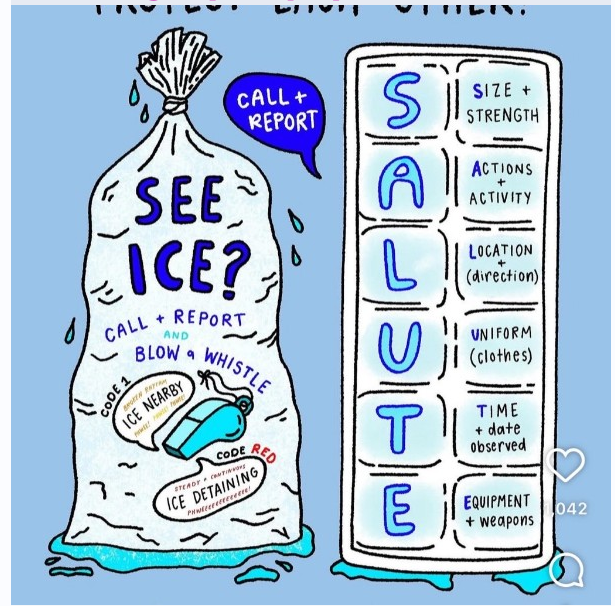
I also went to visit a local brewery where people had gathered to kitbash protest supplies for the next day. We filled bags with water, snacks, gloves, handwarmers, whistles, and first aid materials (particularly treatments for tear gas). Another table over, people were making signs to carry.
I ended the night with a late patrol. It was cold, dark, and generally quiet out in the two suburbs I was in. Other RR chats had a bit more going on. It was on this day that I learned many schools had gone into remote learning. Many classes had reported zero attendance, as parents feared their children being kidnapped.
Friday (1/23):
This morning around 10 o’clock, roughly 100 clerics were arrested blocking the Minneapolis international airport. They understood that they would be arrested for this, but they still chose to do so because the airport was being used to ship out detainees.

From 9-10, I patrolled around Powderhorn and Phillips. Our dispatch was using a grid system to ensure that a driver or commuter could be within a couple minutes of any possible situation. I called out ICE twice during the patrol, but did not witness any arrests. It was noted in the dispatch call that ICE had been trying to box in patrollers with their vehicles; this happened during my patrol to another volunteer and I heard the exchange over the mic. Multiple agents came up to her car, some with weapons drawn. They told her to stop following them and said that this would be her ‘final warning’.
I spent the rest of my morning with DHH. Delivery drivers sign up online for a shift, scan a QR code to join a daily driver chat in person where they can confirm deliveries and report any problems. Once a member of the chat, the driver receives a slip of paper, containing a name, address, and phone number. Drivers are instructed in their training that under no circumstances can they let ICE get a hold of that paper. The church knows they are under observation and drivers have reported being followed. This has forced all drivers to use a buddy system. My buddy was S, a Filipino from Las Vegas, who was new to volunteering at the church.
After a terrifying episode where I briefly lost my slip of paper, I took boxes for five families and headed out. Me and S chatted as we headed out to St. Paul. Only one thing of note occurred: the second delivery’s address was a bit off and we needed to look around to figure out where to deliver it. Now, I was driving a medium-sized, dark vehicle with plates from out of state, and the occupants were two men who clearly didn’t know the area, so we looked quite suspicious. Within a minute of parking, this sweet old lady came out of her home, clearly concerned as to who we were and what we were doing. We explained our situation to her and she went back inside, but this conversation put on display the environment of fear people are living through. We finished our deliveries and headed back.
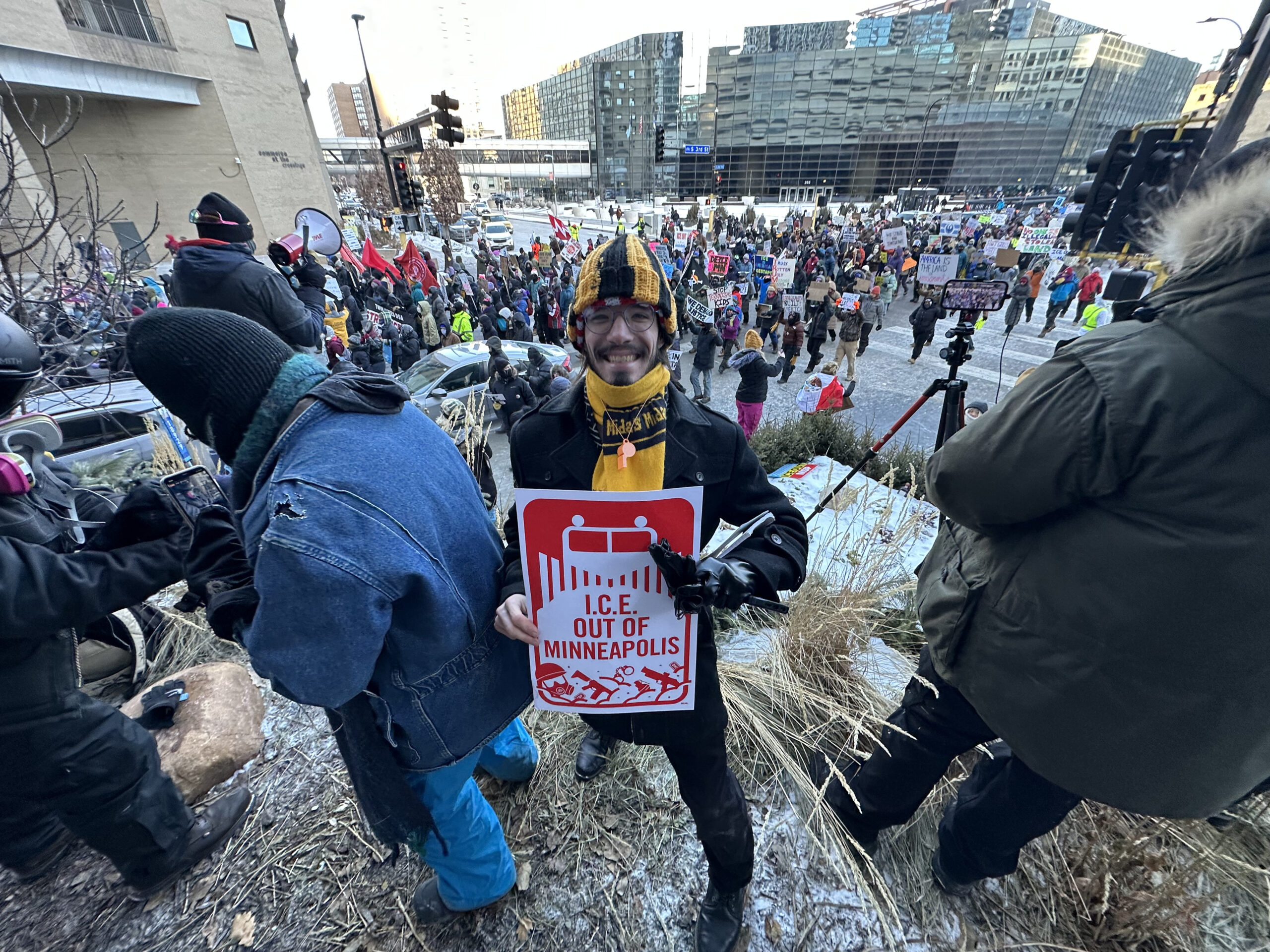
The march was relatively uneventful. This morning City Council had voted unanimously in favor of the ICEOUT. It was amazing to see all those people, signs, props, etc. It was very cold, averaging -23 degrees (without accounting for wind chill), but it hardly put a dent in the crowd. ICE was still active, of course, and many people continued to patrol their neighborhoods. I took a few pictures, answered a question or two with an independent reporter, and eventually met up with the DSA crowd (visible from their red flags).

Everyone was there: the Party for Socialism and Liberation (PSL), Socialist Alternative, the Communist Party, Indivisible, a group of Handmaidens, a group of Native Americans, groups of students, and others. The mood was festive, even amidst the tension. People yelled, chanted, and screamed. Despite the many warnings not to photograph, many people simply could not help themselves – such was the palpable energy. I saw the elderly and the handicapped being helped along the march. No one would be left behind, not even the turtles (yes, someone brought their turtle). I particularly remember a group that had brought a massive tarp, emblazoned with the interlocking hands of workers of all races. They had stopped at a corner and were pulling the tarp up and down. As they raised the tarp, overjoyed young marchers would sprint beneath it to the other side. It was still cold.
There were a number of buildings along the route that were open for people to warm themselves. People were giving out handwarmers, food, and water. A number of people had been given protest kits with additional first aid and tools to handle tear gas.
The march led up to the Target Center stadium. Initially the Center required tickets, but that was quickly waived as the security lines left the stadium. Inside, on a balcony overlooking the crowd, was a dancing Portland frog and a band.


I stayed at the stadium rally for roughly two hours. The previously mentioned Handmaidens had formed a row up front and you could see other groups clustered around the stadium. There was music, a comedian, and a number of speakers. There were Native American leaders, a Muslim teacher, union organizers, an old Southern Baptist preacher, and more. It was noted that over twenty unions worked together to sponsor the event and that five hundred businesses voluntarily closed their doors. Others, presumably, had no choice but to do so.
The Communication Workers of America (CWA) speaker, in particular, spoke of how they viewed each other as family, and that when ICE had taken two or three of their members, they had lost more than just workers. They had lost family, and they had to do everything in their power to get them back. That is what community looks like. It is a lesson we all should take to heart.
Shortly after that, I took my leave. The march stopped at 4, but even at 6:30, outside the Target Center, people were still making their voices heard, in spite of the cold. Over the next 12 or so hours, driving through the dark night, my mind swirled with all the things I had seen, done, and experienced over the last week.
More than any other emotion, I felt rage. The things that I had seen, the stories I had heard, the grave and callous injustices of the situation made my blood boil, as it should any decent human being. But I also saw hope in how their community had come together, and how motivated workers could so quickly build their own systems of resistance when the current system fails us. It is nothing short of inspiring.
The lessons of Minnesota, and how the system continuously fails us as people, are lessons to all of us who want a better tomorrow. They remind us that the powers that be want us to feel afraid and alone. They remind us that the only antidote to that alienation is to seek community with one another, that together there still lies the ability to build better, more just systems. We the People will not comply with a fascist America.
Update:
Driving home from Minnesota, I thought I could not be angrier towards ICE. I was wrong. It is genuinely difficult, even now, to express the anger I feel towards these murders, of Alex Pretti, and of other innocent victims as well. I think of too, if I had asked for that Saturday off instead of the previous Sunday, how easily it could have been me on patrol that Saturday morning as I had been on Friday, just the day before.
The murders ICE has committed have not been accidents. The administration gave guns and badges to murderous thugs and told them that they have total immunity. The administration didn’t know who was going to die, but they should have been well aware that people were going to die. They did not care. Worse, members of the cabinet almost certainly wanted that violence.
The complete moral outcry towards the murder of a nurse who was protecting a woman from thugs has been heartening to say the least. The pressure has worked, to a degree, as it seems ICE will be pulling out of Minnesota. But we can not allow this to lull us into complacency — this only worked because of the hours of work people put into it, going out, organizing, and showing up in the streets, doing their absolute damnedest to make ICE’s job as hard as possible in Minnesota. We must continue this work, if in no small part, to protect us and our communities from further ICE aggression. The pressure must continue with the goal of completely eradicating ICE, there is simply no other way to ensure their crimes are halted. So please remember, Fuck ICE, and support Cleveland DSA and your local organizations in this fight.